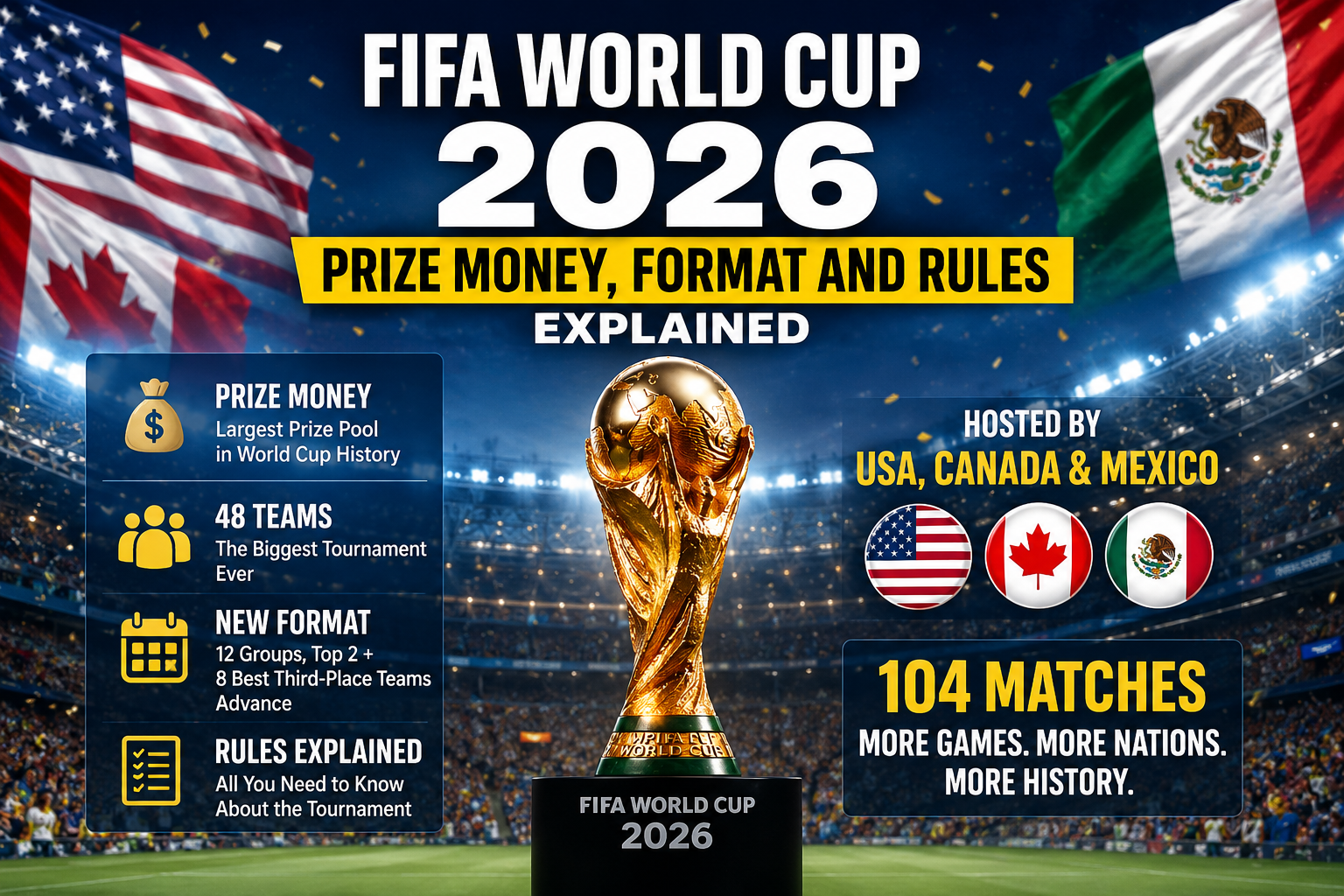
FIFA World Cup 2026 Prize Money, Format and Rules Explained: Everything Fans Need to Know About the Biggest Tournament in Football History
The FIFA World Cup 2026 is set to become the largest and most ambitious tournament in football history. Scheduled to take place across the United States, Canada, and Mexico, the competition will introduce a new format, expanded participation, larger prize pools, and several important tournament regulations that will shape the future of international football.
For football fans, analysts, players, and national teams, understanding the FIFA World Cup 2026 format, prize money structure, qualification system, group-stage rules, knockout procedures, and tournament regulations is essential. As anticipation continues to build, searches for terms such as FIFA World Cup 2026 prize money, FIFA World Cup 2026 format, FIFA 2026 rules, World Cup 2026 teams, FIFA World Cup schedule, and FIFA 2026 tournament structure are growing rapidly across search engines worldwide.
Unlike previous editions of the tournament, FIFA World Cup 2026 will feature major structural changes that are expected to increase competitiveness, create more opportunities for emerging football nations, and generate unprecedented global attention.
This comprehensive guide explains everything football fans need to know about the FIFA World Cup 2026, including how the tournament will work, how teams qualify, how much money is at stake, and why this edition could redefine international football for generations to come.
Why FIFA World Cup 2026 Is Different From Every Previous World Cup
The FIFA World Cup has evolved significantly since its inception in 1930. For decades, the competition featured a relatively limited number of participating nations. Over time, the tournament expanded as football’s popularity grew across every continent.
The 2026 edition represents the biggest expansion in World Cup history. FIFA’s decision to increase the number of participating nations reflects the organization’s broader goal of making international football more inclusive and globally representative.
This expansion allows more countries from Africa, Asia, North America, Oceania, and other regions to compete on football’s biggest stage. As a result, the tournament will feature a wider variety of playing styles, cultures, and football traditions than ever before.
The expanded format is also expected to create new rivalries, increase television audiences, and provide millions of football fans with opportunities to see their national teams participate in the World Cup for the first time.
FIFA World Cup 2026 Format Explained
One of the most significant changes for FIFA World Cup 2026 is the expansion from 32 teams to 48 teams.
This historic increase fundamentally changes the tournament structure.
The competition will feature:
- 48 national teams
- 12 groups
- 4 teams per group
- Expanded knockout rounds
- More total matches than any previous World Cup
Under the current format, each group contains four teams. Every team plays three group-stage matches.
The top two teams from each group automatically qualify for the knockout stage. In addition, the eight best third-placed teams across all groups also advance.
This creates a Round of 32 before the traditional Round of 16.
The result is a longer tournament featuring more matches, more drama, and more opportunities for underdog nations to make history.
How Teams Qualify for FIFA World Cup 2026
Qualification for the FIFA World Cup remains one of the most competitive processes in international sport.
With 48 available places, FIFA has allocated more qualification spots to various continental confederations.
The qualification distribution ensures broader global representation while maintaining competitive standards.
Continents such as Africa and Asia have received significantly more places compared to previous tournaments.
This change means several nations that historically struggled to qualify now have realistic opportunities to reach the World Cup.
For football development worldwide, this expansion is considered one of the most important decisions FIFA has made in recent decades.
Many emerging football nations view the 2026 tournament as a historic opportunity to establish themselves on the global stage.
FIFA World Cup 2026 Host Countries
For the first time in history, three nations will jointly host the FIFA World Cup.
The hosts are:
- United States
- Canada
- Mexico
The United States will host the majority of matches, while Canada and Mexico will also stage important fixtures throughout the tournament.
This tri-nation hosting model is expected to create one of the largest sporting events ever organized.
The host countries offer:
- Modern stadiums
- Advanced transportation infrastructure
- Massive football audiences
- World-class facilities
The geographical scale of the tournament will also make FIFA World Cup 2026 one of the most unique World Cups ever held.
FIFA World Cup 2026 Prize Money Explained
Prize money is one of the most discussed aspects of every FIFA World Cup.
Although FIFA continues to finalize some financial details, football experts widely expect FIFA World Cup 2026 to feature the largest prize pool in tournament history.
Several factors support this expectation.
The tournament will generate enormous revenue through:
- Global broadcasting rights
- Sponsorship agreements
- Ticket sales
- Commercial partnerships
- Digital content distribution
As FIFA revenues continue to increase, participating teams are expected to receive higher financial rewards than in previous editions.
Historically, FIFA has distributed prize money based on tournament performance.
Teams advancing further into the competition receive larger financial rewards.
The eventual world champions earn the largest share of the prize pool, while even group-stage participants receive substantial payments.
For many smaller football federations, World Cup prize money plays a crucial role in funding youth development programs, coaching initiatives, infrastructure projects, and long-term football growth.
How the Group Stage Works
The group stage remains one of the most exciting parts of the World Cup.
Each team plays three matches against opponents within its group.
Points are awarded using the standard system:
- Win: Three points
- Draw: One point
- Loss: Zero points
After all group-stage matches are completed, teams are ranked according to their total points.
If teams finish level on points, FIFA applies several tiebreakers.
These include:
- Goal difference
- Goals scored
- Head-to-head results
- Fair play records
If necessary, additional procedures may be used to determine qualification positions.
The group stage often produces dramatic moments because a single goal can determine whether a nation advances or goes home.
Knockout Stage Structure
The expanded tournament introduces a Round of 32 before the traditional Round of 16.
This means more teams remain in contention for a longer period.
The knockout structure generally follows this progression:
Round of 32
Round of 16
Quarter-finals
Semi-finals
Third-place playoff
Final
Once the knockout rounds begin, every match becomes a high-pressure elimination contest.
There are no second chances.
A single defeat means elimination from the tournament.
This format creates some of the most memorable moments in football history.
Extra Time and Penalty Shootout Rules
Knockout matches cannot end in a draw.
If scores are level after 90 minutes, the match proceeds to extra time.
Extra time consists of two periods of 15 minutes each.
If the teams remain tied after extra time, the match is decided by a penalty shootout.
Penalty shootouts have produced some of football’s most iconic and emotional moments.
For players, coaches, and supporters, they represent one of the most intense experiences in sport.
Technology and VAR in FIFA World Cup 2026
Modern football increasingly relies on technology to improve decision-making.
The FIFA World Cup 2026 is expected to continue using advanced officiating technologies, including:
- Video Assistant Referee (VAR)
- Goal-line technology
- Semi-automated offside systems
- Enhanced match analytics
These technologies aim to improve accuracy while maintaining fairness and transparency.
Although VAR continues to generate debate among fans, it has become an integral part of modern international football.
Why FIFA Expanded the Tournament
FIFA believes the expansion provides several benefits.
More nations gain access to the world’s biggest football competition.
Fans from additional countries become emotionally invested in the tournament.
Football development receives a significant boost across emerging regions.
The expansion also increases commercial opportunities and global engagement.
Critics argue that expansion may reduce competitiveness in some matches.
Supporters, however, believe broader participation strengthens the sport worldwide.
The true impact of expansion will become clearer once the tournament begins.
Economic Impact of FIFA World Cup 2026
The tournament is expected to generate billions of dollars in economic activity.
Host cities will benefit from:
- Tourism
- Hospitality spending
- Transportation demand
- Retail growth
- International exposure
Local businesses are also expected to benefit significantly.
The tournament’s economic impact will likely extend well beyond the final match.
Why FIFA World Cup 2026 Could Become the Biggest World Cup Ever
Several factors contribute to the extraordinary expectations surrounding FIFA World Cup 2026.
The tournament combines:
- More teams
- More matches
- More fans
- Larger venues
- Multiple host nations
- Higher commercial value
These elements create a competition unlike any previous World Cup.
Many football analysts believe the 2026 edition could establish new records for attendance, television audiences, and digital engagement.
Frequently Asked Questions (FAQ)
How many teams will play in FIFA World Cup 2026?
FIFA World Cup 2026 will feature 48 national teams, making it the largest World Cup in history.
What is the new FIFA World Cup 2026 format?
The tournament will include 12 groups of four teams. The top two teams from each group and the eight best third-placed teams will advance to the Round of 32.
Which countries are hosting FIFA World Cup 2026?
The tournament will be jointly hosted by the United States, Canada, and Mexico.
How many matches will be played?
The expanded tournament format will include significantly more matches than previous World Cups, making it the largest FIFA tournament ever organized.
How does World Cup prize money work?
FIFA distributes prize money based on tournament performance. Teams that advance further receive larger financial rewards.
Will VAR be used in FIFA World Cup 2026?
Yes. FIFA is expected to continue using VAR and other advanced technologies to assist referees and improve decision-making.
Why did FIFA increase the number of teams?
FIFA expanded the tournament to increase global participation, improve football development opportunities, and create a more inclusive competition.
What happens if teams finish level on points?
FIFA uses tiebreakers such as goal difference, goals scored, head-to-head results, and fair play records to determine rankings.
Could FIFA World Cup 2026 become the biggest World Cup ever?
Many experts believe it will. The expanded format, larger prize money, multiple host nations, and increased global participation make it one of the most ambitious sporting events ever planned.
Final Thoughts
The FIFA World Cup 2026 represents a historic turning point for international football. With 48 teams, a revolutionary tournament format, larger prize pools, advanced technology, and unprecedented global participation, the competition is set to become the most expansive and commercially successful World Cup ever staged.
For football fans around the world, understanding the FIFA World Cup 2026 prize money, format, rules, qualification process, and tournament structure is essential as the countdown to the biggest sporting event on the planet continues. Whether you support a traditional powerhouse or an emerging football nation, FIFA World Cup 2026 promises to deliver unforgettable moments, historic achievements, and a new chapter in football history.