
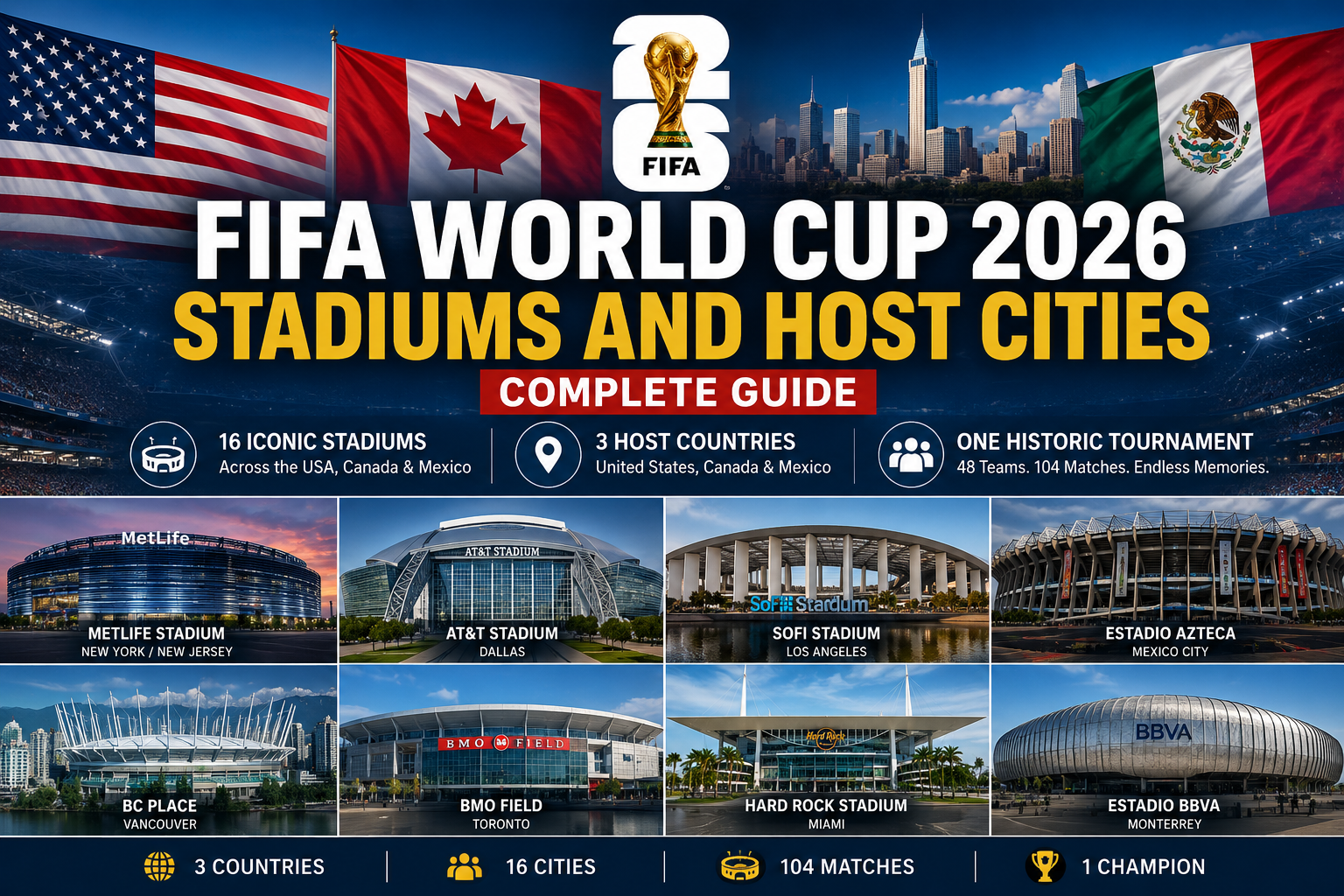
FIFA World Cup 2026 Stadiums and Host Cities: Complete Guide to Every Venue, City and Match Experience
The FIFA World Cup 2026 is set to become the biggest and most spectacular football tournament ever organized. For the first time in FIFA World Cup history, three countries will jointly host the competition, creating an unprecedented football festival across North America. The United States, Canada, and Mexico will welcome millions of fans from around the world as 48 national teams compete for football’s most prestigious trophy.
One of the most exciting aspects of the tournament is the incredible collection of world-class stadiums and host cities selected for the event. From iconic NFL venues in the United States to modern Canadian stadiums and historic Mexican football cathedrals, FIFA World Cup 2026 will showcase some of the finest sporting venues on the planet.
As football fans search for FIFA World Cup 2026 stadiums, FIFA 2026 host cities, World Cup 2026 venues, FIFA World Cup stadium guide, and FIFA 2026 match locations, understanding where the tournament will be played has become one of the most popular topics ahead of the competition.
This complete guide explores every FIFA World Cup 2026 host city, the selected stadiums, their capacities, historical significance, and what fans can expect when the biggest World Cup in history arrives.
Why FIFA World Cup 2026 Is Unique
The 2026 tournament is not just another World Cup. It represents a historic transformation of international football. With 48 teams instead of 32, more matches than ever before, and three host nations working together, FIFA World Cup 2026 will set new records for attendance, viewership, and global engagement.
The decision to use multiple countries was driven by several factors. North America possesses outstanding sports infrastructure, modern transportation systems, and some of the world’s largest stadiums. FIFA recognized that combining the resources of the United States, Canada, and Mexico would create an unforgettable experience for players and supporters alike.
Unlike previous World Cups that were concentrated within one nation, the 2026 edition will spread football across major metropolitan areas, creating a truly continental celebration of the game.
FIFA World Cup 2026 Host Countries
The tournament will be jointly hosted by:
- United States
- Canada
- Mexico
This marks several historic milestones.
Mexico becomes the first nation in football history to host World Cup matches in three different tournaments. The country previously hosted the World Cup in 1970 and 1986.
The United States returns as a World Cup host for the first time since the successful 1994 FIFA World Cup.
Canada hosts World Cup matches for the first time in history, marking a major moment for Canadian football development.
Together, these three countries will create one of the largest sporting events ever staged.
FIFA World Cup 2026 Stadiums in the United States
The United States will host the majority of matches and features the largest number of stadiums.
MetLife Stadium – New York/New Jersey
Located in East Rutherford, New Jersey, MetLife Stadium is expected to be one of the most important venues of the tournament.
Capacity: Approximately 82,500
This stadium regularly hosts major NFL events and international football matches. Its location near New York City makes it one of the most attractive destinations for visiting fans.
Many football analysts believe this venue could host the FIFA World Cup 2026 Final.
AT&T Stadium – Dallas
AT&T Stadium in Arlington, Texas is one of the most technologically advanced sports venues in the world.
Capacity: Approximately 80,000+
Known for its enormous video screen and modern design, it is expected to host several high-profile matches during the tournament.
Texas has a rapidly growing football audience, making Dallas one of the most important host cities.
SoFi Stadium – Los Angeles
Los Angeles remains one of the biggest sports markets globally.
Capacity: Approximately 70,000+
SoFi Stadium is among the newest and most luxurious venues in international sport.
With its state-of-the-art architecture and entertainment facilities, it is expected to be one of the showcase venues of FIFA World Cup 2026.
Mercedes-Benz Stadium – Atlanta
Atlanta has become one of America’s fastest-growing football markets.
Capacity: Approximately 71,000
The stadium is famous for its innovative retractable roof and fan-friendly design.
Its central location makes it ideal for hosting major World Cup matches.
Levi’s Stadium – San Francisco Bay Area
Located in Santa Clara, California, Levi’s Stadium combines modern technology with excellent spectator facilities.
Capacity: Approximately 68,000
The Bay Area’s multicultural population and strong football following make it a natural World Cup destination.
Lumen Field – Seattle
Seattle has one of the most passionate football fanbases in North America.
Capacity: Approximately 69,000
The city’s football culture, strong attendance figures, and vibrant atmosphere are expected to create memorable World Cup experiences.
Lincoln Financial Field – Philadelphia
Philadelphia’s stadium has hosted numerous international sporting events.
Capacity: Approximately 69,000
Its location on the East Coast makes it strategically important for tournament logistics.
Hard Rock Stadium – Miami
Miami is expected to become one of the most vibrant host cities during the tournament.
Capacity: Approximately 65,000
The city’s strong Latin American influence and football-loving culture make it a perfect World Cup destination.
NRG Stadium – Houston
Houston’s diverse population and growing football community have helped establish it as a major football city.
Capacity: Approximately 72,000
The venue’s modern infrastructure makes it ideal for hosting international events.
Arrowhead Stadium – Kansas City
Kansas City continues to gain recognition as an important football market in the United States.
Capacity: Approximately 76,000
The city is expected to deliver an energetic atmosphere throughout the tournament.
Gillette Stadium – Boston
Located near Boston, this venue brings World Cup football to one of America’s most historic regions.
Capacity: Approximately 65,000
The area’s sporting tradition and passionate fans are expected to contribute significantly to the tournament experience.
FIFA World Cup 2026 Stadiums in Canada
BMO Field – Toronto
Toronto is Canada’s largest city and one of North America’s most multicultural urban centers.
Expanded Capacity: Approximately 45,000
The city is expected to attract football fans from around the world due to its international diversity and excellent infrastructure.
BC Place – Vancouver
Vancouver offers one of the most scenic settings among all host cities.
Capacity: Approximately 54,000
The city’s stunning natural surroundings and strong football culture make it one of the most attractive destinations for supporters.
FIFA World Cup 2026 Stadiums in Mexico
Estadio Azteca – Mexico City
No World Cup venue carries more history than Estadio Azteca.
Capacity: Approximately 87,000
This legendary stadium hosted the 1970 and 1986 World Cup Finals and witnessed iconic moments involving Pelé and Diego Maradona.
For many football fans, Azteca represents the spiritual home of World Cup history.
Estadio BBVA – Monterrey
One of Latin America’s most modern football venues.
Capacity: Approximately 53,000
Its impressive architecture and excellent facilities have earned international recognition.
Estadio Akron – Guadalajara
Located in one of Mexico’s most passionate football cities.
Capacity: Approximately 49,000
The venue is known for its distinctive design and electric atmosphere.
Which Stadium Could Host the FIFA World Cup 2026 Final?
Although FIFA’s final scheduling decisions continue to attract attention, several stadiums are considered leading candidates.
The strongest contenders include:
- MetLife Stadium
- AT&T Stadium
- SoFi Stadium
Among these venues, MetLife Stadium is widely viewed as the favorite due to its capacity, location, and infrastructure.
Hosting the final would place the stadium at the center of world football history.
Best Host Cities for Traveling Fans
Every host city offers a unique experience.
New York provides world-famous attractions and global culture.
Los Angeles combines entertainment, beaches, and football.
Miami offers nightlife and Latin American football passion.
Mexico City delivers historic football traditions and legendary stadium experiences.
Toronto and Vancouver provide modern urban environments with outstanding quality of life.
The variety of host cities ensures that supporters will experience far more than just football during the tournament.
Economic Impact of the Host Cities
The FIFA World Cup 2026 is expected to generate billions of dollars in economic activity.
Host cities are preparing for:
- Tourism growth
- Hotel demand
- Transportation expansion
- Retail opportunities
- International media exposure
Local businesses are expected to benefit significantly from the influx of visitors.
The tournament will leave a lasting economic legacy across North America.
Why FIFA Chose These Stadiums
FIFA’s selection process focused on several key factors.
The chosen venues offer:
- Large capacities
- Modern facilities
- Strong transportation networks
- Proven event-hosting experience
- Commercial potential
These stadiums are capable of accommodating the enormous demands of the world’s biggest football tournament.
The Fan Experience at FIFA World Cup 2026
Supporters attending matches can expect an extraordinary experience.
The combination of modern stadiums, advanced technology, vibrant host cities, and diverse cultures will create one of the most memorable World Cups in history.
Fans will have opportunities to explore multiple countries, experience different football traditions, and witness the world’s best players competing on the sport’s biggest stage.
Frequently Asked Questions (FAQ)
How many host cities are there for FIFA World Cup 2026?
The tournament will be played across 16 host cities in the United States, Canada, and Mexico.
Which country hosts the most matches?
The United States will host the majority of World Cup matches.
What is the largest stadium in FIFA World Cup 2026?
Estadio Azteca and MetLife Stadium are among the largest venues selected for the tournament.
Which stadium is the most historic?
Estadio Azteca is widely regarded as the most historic World Cup stadium due to its role in the 1970 and 1986 World Cups.
Could the FIFA World Cup 2026 Final be played in New York?
Many experts consider MetLife Stadium a leading candidate to host the final.
Will Canada host World Cup matches for the first time?
Yes. FIFA World Cup 2026 marks Canada’s first time hosting men’s World Cup matches.
How many countries are hosting FIFA World Cup 2026?
Three countries are hosting the tournament: the United States, Canada, and Mexico.
Which city is expected to attract the most fans?
Cities such as New York, Los Angeles, Miami, Mexico City, and Toronto are expected to attract enormous numbers of international supporters.
Final Thoughts
The FIFA World Cup 2026 stadiums and host cities represent one of the most ambitious sporting projects ever undertaken. With 16 world-class venues spread across three nations, the tournament promises to deliver an unparalleled football experience for players, supporters, and viewers around the globe. From the legendary Estadio Azteca to the ultra-modern stadiums of the United States and Canada, every venue will play a role in shaping what could become the greatest FIFA World Cup in history.